Ashley Cowie, FSA Scot. First published March 1, 2017. Revised edition November 16, 2026.
 https://orcid.org/0000-0001-6872-4759
Abstract. Sysa Hillock, a grassy mound on the south slope of Olrig Hill in Caithness, carries two layers of local tradition, and this paper examines both. Part 1 reads “The Piper of Windy Ha’,” a faerie tale recorded by J. T. Calder in 1887, against the landscape. From Sysa, the site of Windy Ha’ farm lies close to the bearing of the midsummer sunrise, and the tale’s sequence of midsummer day, sleep, sunset and a seven-year bond follows the solar day and the farming year. Part 2 turns to the Norse tradition that places at Sysa the vision in chapter 157 of Njáls saga, in which twelve valkyries weave fate on the day of the Battle of Clontarf in 1014, then ride away six to the north and six to the south. The six-and-six division may echo the summer and winter halves of the Old Icelandic year. Both readings are offered as hypotheses, together with the fieldwork needed to test them.
Keywords: Sysa Hillock; Caithness; faerie lore; Piper of Windy Ha’; Njáls saga; valkyries; summer solstice; archaeoastronomy
1. Introduction
Folk tales, legends and myths carry the beliefs of the communities that tell them. In societies without written science, gods, demons and faeries gave order to events that could not otherwise be explained.
In northern Scotland, land was also a cause of conflict. Barbara E. Crawford’s Scandinavian Scotland (1987) shows how farmland and coastal resources drove competition between Pictish and Norse groups in Caithness between the ninth and twelfth centuries. [1] Folklore in the county carries the layers of that contact: Celtic and Christian faerie belief beside Norse traditions of Odin’s valkyries.
In 2006 I rented a cottage at Weydale, on Olrig Hill, about 3 miles (5 km) southeast of Thurso, during a research expedition. At the edge of the moor behind the cottage stands a grassy mound about 30 feet (9 m) high. Its formal name is Sysa Hillock; locally it is called “Faerie Hill.”
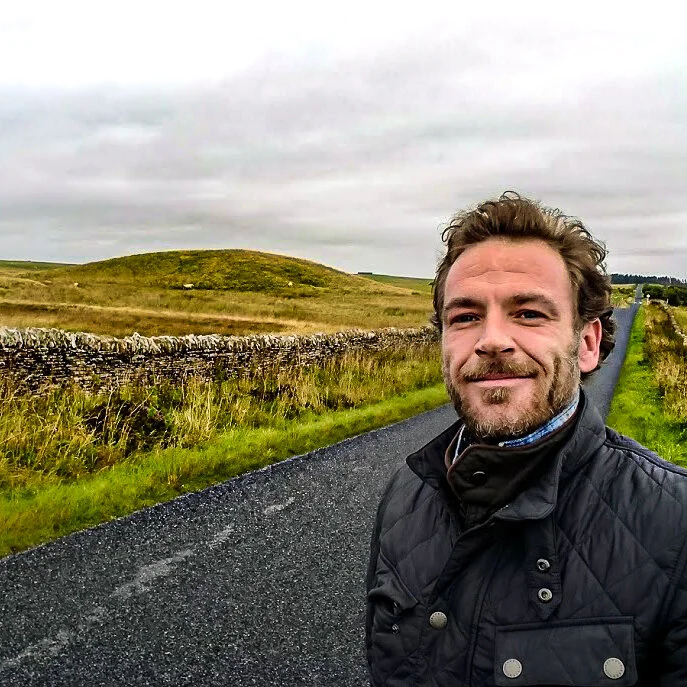
Figure 1. The author on Olrig Hill, near Sysa Hillock.
Two traditions are associated with Sysa. The first is a Celtic faerie tale, “The Piper of Windy Ha’,” which ties the mound to a midsummer day and a seven-year bond. The second is Norse: a vision of twelve valkyries weaving the fate of a battle. Part 1 of this paper examines the faerie tale and its possible link to the midsummer sunrise. Part 2 examines the Norse tradition and its possible link to the Norse year. The final sections weigh the two together.
2. Study Area
Sysa Hillock lies at Ordnance Survey grid reference ND 169 647 (58.5624° N, 3.4301° W), on the southern slope of Olrig Hill, beside the old route between Wick and Thurso. The nineteenth-century historian J. T. Calder recorded both traditions as centered on the hillock and on a well beside it, which, he noted, dried up after agricultural improvements in his own century. [2] My own fieldwork places the spring below the mound, to the southeast.
Figure 2. Sysa Hillock, at Ordnance Survey grid reference ND 169 647, shown on a nineteenth-century map of the county of Caithness.
The farm of Windy Ha’ stood on the northern slope of Olrig Hill, and an old farm track linked it to Sysa. The Highland Historic Environment Record places Windy Ha’ at ND 1795 6605, about 1.1 miles (1.7 km) north-northeast of Sysa. [3]
Figure 3. The site of the Sysa Well, marked by the four sheep at lower right.
Part 1: The Piper of Windy Ha’
3. The Source: Calder’s “Piper of Windy Ha’”
Calder’s version runs as follows. On a warm June afternoon, a young man named Peter of Windy Ha’ drank from the well at Sysa and fell into a deep sleep, waking near sunset. Before him stood the Faerie Queen, a young woman dressed in green. She offered him a choice: a set of silver-mounted pipes that would bring fame and wealth, or a Bible that would bring spiritual riches and material poverty. Peter chose the pipes and found he could play them at once. In return, he swore to meet her at the well at the same hour seven years later.
Peter’s parents urged him to throw the pipes away. He ignored them and grew rich playing across Scotland. Seven years later, near sunset, he set out for Sysa with his dog. Halfway there he sent the dog home, and it howled as he crossed the brow of Olrig Hill. He was never seen again. Local people said the Faerie Queen lived inside Sysa Hillock, and that on moonlit nights his pipes could still be heard on the moor. [2]
4. The Seven-Year Bond in Scottish Faerie Tradition
The tale follows a familiar pattern. A young man ignores his parents, chooses material reward over a spiritual life, and is bound to an otherworldly being for seven years. The same term recurs across Scottish tradition:
In the Border ballad Tam Lin, the faeries pay a tribute, or “teind,” to hell every seven years, and Tam Lin fears he will be that tribute. [4]
In Thomas the Rhymer, Thomas serves the Queen of Elfland for seven years. [4]
In Andrew Lang’s The Gold of Fairnilee (1888), Randal is carried off to Fairyland for seven years. [5]
In Mollie Hunter’s The Haunted Mountain (1972), the farmer MacAllister is held by the faeries for seven years after farming a forbidden field. [6]
In Naomi Mitchison’s The Big House (1950), a piper escapes from a faerie hill after two terms of seventy years. [7]
In each case the bond is a contract with the Faerie Queen or her people, and its length is counted in years, that is, in cycles of the sun.
5. The Number Seven and the Sky
The classical world recognized seven “planets” visible to the naked eye: the Sun, Moon, Mercury, Venus, Mars, Jupiter and Saturn. They gave their names to the seven days of the week, and the number seven became tied to the heavens and to the measurement of time. [8] J. E. Cirlot’s Dictionary of Symbols links seven to completeness and to the ordering of space and time. [9] Bruno Bettelheim suggested that the seven dwarfs of Snow White may echo the seven planets of the ancient world. [10]
Figure 4. The constellation Orion. The three stars of Orion’s Belt point up toward the Pleiades and down toward Sirius.
The Pleiades, an open star cluster in Taurus, are known across Europe as the Seven Sisters. In the northern winter sky, the three stars of Orion’s Belt point up toward the Pleiades and down toward Sirius. Many cultures used the cluster’s rising and setting to mark the seasons. [11]
6. A Solar Reading of the Tale
The tale names two fixed places, and on nineteenth-century Ordnance Survey maps a farm track joins them. Studies of prehistoric monuments show that mounds and stones were often placed to mark the rising or setting of the sun at the solstices. [12] [13] That makes it worth asking whether the line from Sysa to Windy Ha’ has a solar meaning.
Figure 5. The old hill road (orange) from Windy Ha’ to Sysa Hillock.
Measured from Sysa, Windy Ha’ lies about 37° east of north. At this latitude the midsummer sun rises in the northeast, close to that bearing, behind Olrig Hill. On a level horizon its first gleam appears at about 37° today, and about one degree farther north around 3000 BCE, when the tilt of the earth’s axis was greater. Seen from the mound, then, the midsummer sun would rise from the direction of Windy Ha’. The height of the skyline over Olrig Hill has not yet been measured; a higher skyline would move the sunrise a few degrees east.
If the piper is read as the sun, the tale’s sequence maps onto the solar year:
Peter sets out from Windy Ha’ at midsummer: the sun rises at the summer solstice, from the direction of Windy Ha’.
He drinks at Sysa and sleeps through the afternoon: the sun passes its height and declines.
He wakes near sunset to meet the Faerie Queen: the moon rises as the sun sets.
Seven years of fame and wealth: seven cycles of the sun, seven completed harvests.
He returns at sunset and enters the mound: the sun sets and the cycle closes.
Figure 6. From Sysa, Windy Ha’ lies close to the bearing of the midsummer sunrise over Olrig Hill.
If such an alignment was intended, it could date from the Neolithic (c. 4000–2500 BCE), when the solstice marked a key moment in the farming year.
Part 2: The Valkyries of Sysa
7. Sigurd the Stout and the Raven Banner
The second tradition at Sysa is Norse, and darker. It concerns Earl Sigurd Hlodvirsson, known as Sigurd the Stout, who ruled Orkney and Caithness from about 991 until his death in 1014. Orkneyinga saga, written in Iceland around 1200, presents him as a powerful ruler who defended Caithness against the Scots and raided the Hebrides and Ireland. [14] The saga records that his mother, Eithne (Old Norse Eðna; the “Audna” of earlier English retellings), made him a banner bearing a raven, the bird of Odin. She told him it would bring victory to the man it was carried before, but death to the man who carried it. [15]
Figure 7. Detail from the Bayeux Tapestry showing a Norman knight carrying a banner with a bird motif, often identified as a raven banner. Public domain.

In 1014 Sigurd sailed to Ireland to fight for Sigtrygg Silkbeard, the Norse king of Dublin, and his Leinster allies against Brian Boru, High King of Ireland. At the Battle of Clontarf, fought on Good Friday, April 23, 1014, both Brian and Sigurd were killed; by the saga’s account Sigurd was carrying the raven banner himself. [16]
8. The Weavers at Sysa
Chapter 157 of Njáls saga records what happened in Caithness on the same day. A man named Dörruðr (Latinized as Daraddus) saw twelve riders go into a building. Looking in through an opening, he saw women weaving on a loom that used men’s heads for weights and men’s entrails for warp and weft, with a sword as the beater and an arrow as the shuttle. As they wove they sang the poem now called Darraðarljóð, naming themselves as valkyries and foretelling the deaths of a king and an earl. When the web was finished they tore it down, each keeping the piece she held, and rode away, six to the north and six to the south. [17] The saga places the scene only in Caithness; Caithness tradition places it at Sysa. [18]
That final image, the twelve riding off six to the north and six to the south, is the starting point for what follows.
9. Valkyries and Norns
Modern retellings often present valkyries as graceful maidens, but the Old Norse valkyrja means “chooser of the slain.” In the older sources they are female spirits in Odin’s service who decide who will fall in battle and bring the chosen dead to Valhalla. [19] In later saga literature the figure blends with that of the human shield-maiden and the swan maiden, women who fight or love as mortals. [20]
Figure 8. Helgi und Sigrun by Johannes Gehrts, 1901. Public domain.

Alongside the valkyries stand the Norns, Urd, Verdandi and Skuld, who live by the Well of Urd beneath Yggdrasil, the world tree whose roots and branches reach through the Nine Worlds. Snorri Sturluson describes them shaping the lives of men, and the poem Völuspá has them carving on wood, a phrase usually read as cutting runes. [21] Their names are often glossed as past, present and future, but that reading assumes a linear sense of time. Skuld is related to words for debt and obligation, so it may mean what must come to be rather than simply what is to come. [22]
Figure 9. The Norns Urd, Verdandi and Skuld beneath the world tree Yggdrasil, by Ludwig Burger, 1882. Public domain.
The valkyries of Darraðarljóð do the Norns’ work: they weave fate. At Sysa that idea is set in a real place, with a well beside the hillock that recalls the Well of Urd. The parallel suggests, though it cannot prove, that the tradition maps a cosmological picture onto local landscape.
Medieval Icelandic writers often dated events relative to one another rather than to a fixed era, for example so many winters after a well-known battle. [23] Part 1 read the faerie tale as an allegory of the sun’s year. The question here is whether the Norse tradition carries a comparable meaning.
10. The Twelve: Gods, Land and Calendar
Norse sources give the number twelve a place in the order of the gods. Snorri describes Gladsheim, the hall of the gods in Asgard, with seats for twelve beside Odin’s high seat, and Vingólf as the hall of the goddesses. [24] Twelve-fold divine assemblies appear elsewhere too, for example in the twelve Olympians of Greece. The twelve weavers at Sysa may echo this cosmic order.
Norse rule in northern and western Scotland brought land assessment in ouncelands and pennylands. In Orkney, and probably Caithness, there were 18 pennylands to the ounceland; in western Scotland there were 20. [25] Pennyland survives in Caithness place-names. I tested whether a twelve-part division of the land centered on Sysa might survive in field boundaries. On a nineteenth-century map I drew six lines through Sysa at 30° intervals, dividing the landscape into twelve equal sectors (Figure 10), and in the summer of 2012 I walked Olrig Hill looking for boundaries, ditches or dykes that followed them. I found no clear correspondence.
Figure 10. Twelve sectors at 30° intervals radiating from Sysa Hillock, drawn on a nineteenth-century map.
The Old Icelandic calendar divided the year into two halves, summer and winter, each of six 30-day months, with extra days added to keep step with the seasons. [26] The winter months were Gormánuður, Ýlir, Mörsugur, Þorri, Góa and Einmánuður; the summer months were Harpa, Skerpla, Sólmánuður, Heyannir, Tvímánuður and Haustmánuður. In the far north the two halves carry the extremes of light: skammdegi, the time of short days, and náttleysi, the nightless summer.
Figure 11. The twelve months of the Old Icelandic calendar overlaid on Sysa Hillock.
The twelve riders who part six to the north and six to the south could therefore echo the year itself: six months of summer and six of winter, with the sun low in the south through the winter half. Strictly, these months were counted, not lunar, so the pattern is calendrical rather than tied to the moon.
11. Discussion and Limitations
Read together, the two traditions give Sysa two possible layers of sky lore: a Celtic tale that can be set against the midsummer sunrise over Olrig Hill, and a Norse vision built on the number twelve and on a six-and-six division that matches the halves of the Norse year. In the eddic tradition the sun and moon, Sól and Máni, are sister and brother driving horses across the sky, an image older than the Viking Age in northern Europe, as the Bronze Age Trundholm sun chariot shows. [27]
The evidence has clear limits:
The sightline. Windy Ha’ is a historic farm, and the age of the track is unknown, so a line between them cannot itself be Neolithic. The claim is that the farm and track may preserve an older sightline from Sysa to the midsummer sunrise. The two national records also disagree on where Windy Ha’ stood: the position used here matches the 1877 Ordnance Survey map, but the other would lie about 54° from Sysa. [3]
The mound. The date and nature of Sysa Hillock are unconfirmed. It may be prehistoric, and only excavation or survey can settle that.
The faerie tale. The tale survives in a nineteenth-century literary version. Calder may have shaped it, and the seven-year term is common across Scottish faerie lore, so it need not point to this site alone.
The Norse vision. Njáls saga was written in Iceland around 1280, more than two centuries after Clontarf, and Darraðarljóð is a battle poem, not a calendar. The saga does not name Sysa; that link comes from Caithness tradition recorded in the nineteenth century.
The twelve sectors. The twelve-sector grid found no support in the field, and the calendar reading is a hypothesis about symbolism.
Three field tests would settle much of this: a measured bearing and skyline profile from Sysa toward Olrig Hill, a sunrise observation from the mound on June 21, and a proper study of the Sysa well and the mound itself.
12. Conclusion
Sysa Hillock carries two layers of tradition. “The Piper of Windy Ha’” ties two real places to a midsummer day and a seven-year term, and from Sysa, Windy Ha’ lies close to the bearing of the midsummer sunrise. The Norse vision of twelve valkyries, who weave fate and then ride six to the north and six to the south, may echo the summer and winter halves of the Norse year. Read together, they suggest that Sysa may have been remembered as a place where the order of the sky was tied to the land, as oral tradition preserved other seasonal knowledge in the landscape. That suggestion rests on folklore and comparison rather than excavation or measured survey, and fieldwork can now confirm or reject it.
Notes
Crawford, Scandinavian Scotland.
Calder, Sketch of the Civil and Traditional History of Caithness, 55–61.
Highland Historic Environment Record, “MHG19433 – South Lodge, Olrig House”; Canmore, “Windy Ha’.”
Child, English and Scottish Popular Ballads, no. 39 (Tam Lin) and no. 37 (Thomas Rymer).
Lang, The Gold of Fairnilee.
Hunter, The Haunted Mountain.
Mitchison, The Big House.
Liabenow, “Significance of the Numbers Three, Four, and Seven.”
Cirlot, Dictionary of Symbols, s.v. “seven.”
Bettelheim, The Uses of Enchantment.
Andrews, The Seven Sisters of the Pleiades.
Heggie, Megalithic Science.
Ruggles, Astronomy in Prehistoric Britain and Ireland.
Pálsson and Edwards, Orkneyinga Saga, chaps. 11–12.
Pálsson and Edwards, Orkneyinga Saga, chap. 11.
Bayerschmidt and Hollander, Njál’s Saga, chaps. 155–57.
Bayerschmidt and Hollander, Njál’s Saga, chap. 157.
Calder, Sketch of the Civil and Traditional History of Caithness, 55–61; Cowan, “Caithness in the Sagas.”
Simek, Dictionary of Northern Mythology, s.v. “valkyries.”
Orchard, Dictionary of Norse Myth and Legend, s.v. “valkyries.”
Sturluson, Prose Edda, Gylfaginning chaps. 15–16; Simek, Dictionary of Northern Mythology, s.v. “Norns.”
Simek, Dictionary of Northern Mythology, s.v. “Skuld.”
Ceolin, “Multiple Facets of Time,” 59–63.
Sturluson, Prose Edda, Gylfaginning chap. 14.
Williams, “The dabhach Reconsidered,” 17–18; Oram, “Ouncelands, Quarterlands and Pennylands.”
Ceolin, “Multiple Facets of Time,” 26–38.
Sturluson, Prose Edda, Gylfaginning chaps. 11–12.
Bibliography
Andrews, Munya. The Seven Sisters of the Pleiades: Stories from Around the World. North Melbourne: Spinifex, 2004.
Bayerschmidt, Carl F., and Lee M. Hollander, trans. Njál’s Saga. New York: New York University Press for the American-Scandinavian Foundation, 1955.
Bettelheim, Bruno. The Uses of Enchantment: The Meaning and Importance of Fairy Tales. New York: Knopf, 1976.
Calder, James T. Sketch of the Civil and Traditional History of Caithness from the Tenth Century. With historical notes by Thomas Sinclair. 2nd ed. Wick: William Rae, 1887. Reprint, 1973.
Canmore. “Windy Ha’.” Canmore ID 195885. Historic Environment Scotland. https://canmore.org.uk/site/195885.
Ceolin, Martina. “The Multiple Facets of Time: Reckoning, Representing, and Understanding Time in Medieval Iceland.” PhD diss., Ca’ Foscari University of Venice and University of Iceland, 2020.
Child, Francis James, ed. The English and Scottish Popular Ballads. Vol. 1. Boston: Houghton Mifflin, 1882–84.
Cirlot, J. E. A Dictionary of Symbols. Translated by Jack Sage. 2nd ed. London: Routledge, 2002.
Cowan, Edward J. “Caithness in the Sagas.” In Caithness: A Cultural Crossroads, edited by John R. Baldwin, 25–44. Edinburgh: Scottish Society for Northern Studies, 1982.
Crawford, Barbara E. Scandinavian Scotland. Leicester: Leicester University Press, 1987.
Heggie, Douglas C. Megalithic Science: Ancient Mathematics and Astronomy in North-West Europe. London: Thames and Hudson, 1981.
Highland Historic Environment Record. “MHG19433 – South Lodge, Olrig House.” Highland Council. https://her.highland.gov.uk/Monument/MHG19433.
Hunter, Mollie. The Haunted Mountain. London: Hamish Hamilton, 1972.
Lang, Andrew. The Gold of Fairnilee. Bristol: J. W. Arrowsmith, 1888.
Liabenow, Amanda. “The Significance of the Numbers Three, Four, and Seven in Fairy Tales, Folklore, and Mythology.” Honors project, Grand Valley State University, 2014. https://scholarworks.gvsu.edu/cgi/viewcontent.cgi?article=1409&context=honorsprojects.
Mitchison, Naomi. The Big House. London: Faber and Faber, 1950.
Oram, Richard. “Ouncelands, Quarterlands and Pennylands in the Western Isles, Man and Galloway: Tribute Payments and Military Levies in the Norse West.” In Taxes, Tributes and Tributary Lands in the Making of the Scandinavian Kingdoms in the Middle Ages, edited by Steinar Imsen. Trondheim: Tapir Academic Press, 2011.
Orchard, Andy. Dictionary of Norse Myth and Legend. London: Cassell, 1997.
Pálsson, Hermann, and Paul Edwards, trans. Orkneyinga Saga: The History of the Earls of Orkney. London: Hogarth Press, 1978. Reprint, Harmondsworth: Penguin, 1981.
Ruggles, Clive. Astronomy in Prehistoric Britain and Ireland. New Haven: Yale University Press, 1999.
Simek, Rudolf. Dictionary of Northern Mythology. Translated by Angela Hall. Cambridge: D. S. Brewer, 1993.
Sturluson, Snorri. The Prose Edda. Translated by Arthur Gilchrist Brodeur. New York: American-Scandinavian Foundation, 1916.
Williams, Gareth. “The dabhach Reconsidered: Pre-Norse or Post-Norse?” Northern Studies 37 (2003): 17–32.