Architect of Liberty: How America’s Scottish President Blocked the Slave State
On February 2, 1787, Scottish born Arthur St. Clair was elevated to the presidency of the Continental Congress, assuming leadership of a revolutionary America in its twilight hours before the Constitution. Long before the modern office of the United States executive was established, this early American president held the highest political seat in the nascent republic. Decades prior to his ascension, that same destiny began in a vastly different world, where a biting sea air greeted him as a newborn.
There is a particular, brilliant melancholy to Caithness - a landscape on the coast of Thurso where the northern crags meet the wild North Sea. It was from this remote Scottish outpost that St. Clair would depart, destined to exchange his homeland for the unmapped frontiers of the New World, leaving a legacy that ultimately helped forge the architecture of a global superpower.
Rise of the Northern Lion
Figure 01: Arthur St. Clair. Portrait by Charles Willson Peale, c. 1783. Public domain.
In the historiography of the transatlantic revolutionary era, certain pivotal actors frequently fall into obscurity, necessitating deliberate archival and biographical reclamation. For over two decades, researcher and author R. W. Dick Phillips has examined the legacy of Major General Arthur St. Clair, a figure whose contributions have remained largely marginalized in mainstream American and British historical narratives. Phillips’s 2014 monograph, Arthur St. Clair: The Invisible Patriot, provides a critical re-examination of this dual-heritage icon, positioning him not merely as a conventional military officer, but as a progressive ideologue who actively challenged early American socio-political frameworks. Most notably, St. Clair’s tenure as President of the Continental Congress coincided with the passage of the Northwest Ordinance of 1787 - a watershed legislative milestone containing Article 6, which legally prohibited the expansion of human chattel slavery into the newly designated Northwest Territory, directly confronting the most malignant institutional element of the contemporary Anglo-American world. [ref 1]
Lineage and Socio-Economic Realities
St. Clair’s reformist trajectory presents a compelling socio-economic paradox when contrasted with his ancestral lineage. He descended from the St. Clair Barons of Rosslyn in southeast Scotland, a prominent aristocratic dynasty that exerted substantial influence over the nation's socio-political and military architecture from the thirteenth through the nineteenth centuries. Historical precedents within this house include Henry Sinclair, Second Earl of Orkney, who served as guardian to the future King James I, and Sir William St. Clair, Third Earl of Orkney, who commissioned the construction of Rosslyn Chapel in 1446.
While certain historiographical traditions posit that St. Clair enjoyed a youth of financial security in Thurso sustained by an ancestral inheritance, Phillips’s revisionist analysis challenges this assumption of intergenerational wealth transfer. The immense capital reserves historically associated with the Rosslyn St. Clairs - documented as enabling the family to "dine on plates of silver and gold" - had failed to trickle down to the early eighteenth-century Caithness branch of the family. Empirical evidence indicates that Arthur St. Clair was born into a household of modest mercantile means. Consequently, his eventual socio-political ascent within the administrative structures of the New World was predicated not on inherited colonial capital, but on personal merit and strategic adaptation. [ref 2]
Figure 02: Thurso, Caithness, Scotland: Formative geographic setting of Major General Arthur St. Clair (b. 1736) and the author's locus of upbringing. Public Domain.
From Edinburgh Medicine to the Transatlantic Theater
In the absence of paternal resources, St. Clair’s early development was directed by his mother, who provided an advanced education designed to bypass the restricted socio-economic pathways of eighteenth-century Caithness. At the time, youth transitioning from formal schooling in Thurso were largely confined to agrarian labor, maritime fishing, or enlistment in the ranks. Instead, his maternal instruction in classical languages and aristocratic social arts facilitated a trajectory toward the professions. St. Clair initially matriculated at the University of Edinburgh to study medicine, later securing an apprenticeship in London under the pioneering anatomist and obstetrician Dr. William Hunter. However, the death of his mother dissolved his remaining domestic ties, precipitating a shift from medicine to military service. Influenced by the martial rhetoric of the Duke of Cumberland regarding Anglo-French colonial rivalry in North America, St. Clair purchased an Ensign's commission in 1757, transitioning to the transatlantic theater to engage French forces in Canada.
Pre-Revolutionary Border Conflict
In 1774, while serving as a magistrate appointed by Pennsylvania Governor John Penn, St. Clair confronted a territorial annexation attempt by Virginia’s Royal Governor, Lord Dunmore, who sought to claim the strategic Three Rivers region surrounding Fort Pitt (modern Pittsburgh). St. Clair twice arrested Dunmore’s agents to secure Pennsylvania’s jurisdiction. Concurrently, he stabilized the western frontier by organizing a volunteer militia and mobile patrols to protect regional settlers from frequent Indigenous raids. St. Clair later exposed intelligence revealing that Dunmore had actively incited these tribal hostilities to destabilize the region and deter colonists from joining the revolutionary movement. [ref 3]
Revolutionary Command and Ticonderoga
Detail of a 1758 map showing the fort's layout. Public Domain.
Following escalating British hostilities, St. Clair met with Continental Congress President John Hancock in 1775 and was commissioned as a Colonel under George Washington, rising to Major General within two years. In July 1777, he assumed command of Fort Ticonderoga in New York. Though Congress publicly asserted the fortress was impregnable, the decaying site was severely undermanned, holding fewer than 2,500 troops against an advancing British force of over 8,000.
When British artillery successfully occupied the overlooking high ground of Mount Defiance, rendering the fort indefensible, St. Clair executed a swift evacuation under cover of darkness. Despite facing an initial court-martial fueled by public outrage, his tactical retreat preserved vital personnel who subsequently secured the pivotal American victory at the Battle of Saratoga. The subsequent congressional inquiry fully exonerated St. Clair, commending his strategic judgment under duress. [ref 4]
Strategic Contributions to the New Jersey Campaign (1776–1777)
Lord Stirling leading an attack against the British in order to enable the retreat of other troops at the Battle of Long Island, 1776. Painting by Alonzo Chappel, 1858. Public Domain.
Following a series of severe tactical defeats in the New York theater during late 1776, the Continental Army faced near-total dissolution. General George Washington’s forces had retreated across New Jersey, suffering an estimated 90 percent attrition rate through casualties, desertions, and expired enlistments, leaving the remaining core of the army critically depleted.
In December 1776, Brigadier General Arthur St. Clair reinforced Washington’s command by bringing forward a fresh brigade of approximately 2,000 men, significantly altering the operational balance. During the council of war preceding the subsequent maneuvers, St. Clair advocated for a strategy of stealth and rapid night marches. This tactical approach proved vital during the Ten Crucial Days following Christmas 1776, enabling the Continental Army to secure successive victories at Trenton, Assunpink Creek, and Princeton. By outmaneuvering British forces under Lord Cornwallis, these engagements effectively compelled the British to evacuate most of New Jersey, reversing the momentum of the war and preserving the operational viability of the American Revolution. [ref 5]
Historiographical Erasure and the Washington-St. Clair Dynamic
The political fallout of the late 1776 campaign extended deep into the Continental Congress, where factional dissatisfaction had left leadership poised to challenge Washington’s supreme command. The strategic turnaround in New Jersey effectively insulated Washington from his political detractors, consolidating his reputation both domestically and internationally as the foundational military strategist of the conflict. Conversely, St. Clair's decisive operational intelligence during the Council of War was largely absorbed into Washington's overarching command legacy. Recognizing the tactical value of his subordinate's contribution, Washington promoted St. Clair to Major General within weeks of the Princeton engagement.
In Arthur St. Clair: The Invisible Patriot, R. W. Dick Phillips positions the complex, interconnected relationship between Washington and St. Clair as a central thematic axis. Phillips documents 135 distinct points of contact and correspondence between the two generals - archival evidence frequently overlooked by mainstream historiography, which tends to attribute collective operational victories exclusively to the high command. Phillips argues that this systemic focus on top-tier figures has resulted in a centuries-long academic erasure. Consequently, standard educational curricula have largely omitted the Caithness-born strategist, obscuring a figure whose tactical acumen was arguably indispensable to the ultimate success of the American revolutionary project.
Administrative Legacies and the Northwest Ordinance
Following his tenure in the Continental Congress, St. Clair was appointed as the first Governor of the Northwest Territory, a vast frontier region that would eventually be partitioned into the states of Ohio, Indiana, Illinois, Michigan, Wisconsin, and part of Minnesota. In this executive capacity, St. Clair oversaw the foundational civil and judicial administration of the territory, establishing its initial court systems, legal frameworks, and structural governance.
Central to his administrative legacy was his role in implementing and enforcing the Northwest Ordinance of 1787. This organic act established the precedent by which the United States would expand westward through the admission of new, equal states rather than the expansion of existing colonial territories - a mechanism so structurally sound that it served as the baseline statutory framework for the admission of late-tier territories like Alaska and Hawaii in the mid-twentieth century. Uniquely, the Ordinance represented a profound milestone in early American civil law: it contained an explicit federal prohibition against the introduction of human chattel slavery within the territory, establishing a crucial anti-slavery precedent decades before the systemic national conflicts of the nineteenth century. [ref 06]
Partisan Confrontation and the Ohio Statehood Crisis
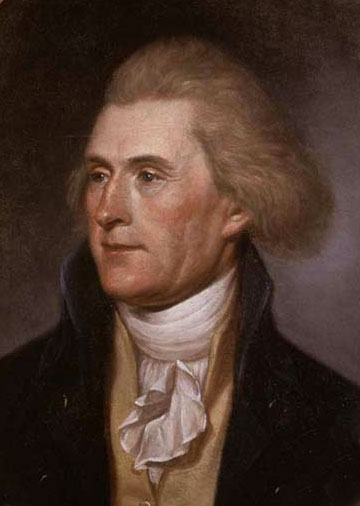
Thomas Jefferson in 1791 at 49 by Charles Willson Peale opposed St. Clair's motion to abolish slavery. Public Domain.
When St. Clair initiated his civil administration, the domestic geopolitical landscape was deeply fractured along partisan lines. As a staunch Federalist, St. Clair’s efforts to organize the Northwest Territory - including the establishment of Ohio’s initial nine foundational counties and their respective administrative seats - placed him in direct opposition to Thomas Jefferson’s Democratic-Republican faction. This fourteen-year gubernatorial tenure became a protracted struggle over executive authority, territorial division, and the timeline for statehood.
The political friction culminated during the 1802 Ohio Constitutional Convention. Fearing that incoming Democratic-Republican delegates would attempt to bypass or weaken the anti-slavery mandate established by Article 6 of the Northwest Ordinance, St. Clair delivered a controversial, politically charged address to the convention floor. In his speech, he vehemently critiqued the congressional Enabling Act of 1802, declaring it a legal nullity that infringed upon the rights of territorial citizens.
Exploiting this public denunciation of federal authority, President Thomas Jefferson executed a decisive tactical maneuver, removing St. Clair from the governorship in November 1802 to clear the path for Republican leadership. Despite St. Clair's dismissal, his long-term obstruction of pro-slavery interests secured its intended effect. When anti-extension and pro-slavery factions ultimately clashed over the final text of the state constitution, the push to subvert the Ordinance's anti-slavery restriction failed by a margin of just a single vote. This critical statutory victory legally anchored Ohio as a free state upon its admission in 1803, finalizing a legal framework that dictated a slave-free trajectory for the subsequent five states carved from the territory. [ref 7]
Conclusion: Historiographical Legacy and Transatlantic Memory
Major General Arthur St. Clair did not leave his name inscribed upon grand monuments or opulent estates; instead, his final years were spent in modest, wooden dwellings, far removed from the centers of the power he helped construct. Apart from localized historical markers, his legacy remains largely a whisper within the fading historical landscapes of the American Midwest and his native Scotland. He lies buried in Greensburg, Pennsylvania, alongside his wife Phoebe, both having passed away in 1818.
Yet, St. Clair’s historical erasure belies the structural magnitude of his achievements. While foundational folklore often favors romanticized, martial figures of rebellion, this son of Caithness enacted a far more systemic transformation on the global stage. Confronting deeply entrenched colonial institutions, partisan adversaries, and the immense economic interests of the early modern slave trade, St. Clair leveraged administrative and constitutional frameworks to install durable legal paradigms of liberty. By structurally preventing the expansion of human chattel slavery across the Northwest Territory, his governance effectively disrupted the trajectory of the early American republic, preventing it from solidifying as a comprehensive slave-holding empire. The legal scaffolding established by this Thurso-born administrator ultimately shattered the systemic horizon of bondage for thousands of future human beings. [ref 8]
Historiographical Postscript and Future Directives
The modern reclamation of St. Clair is heavily indebted to the revisionist methodologies of independent researchers such as R. W. Dick Phillips, whose archival investigations challenge standard, top-down national narratives to uncover forgotten nodes of transatlantic history. Given the profound geopolitical impact of this dual-heritage legacy - and the shared geographical crucible of a Caithness upbringing - the next logical phase of this inquiry demands a shift toward visual and narrative media. Future research directives will focus on translating these archival insights into a comprehensive documentary film script. By utilizing digital media to trace St. Clair's trajectory from the crags of Thurso to the early American presidency, this upcoming cinematic project aims to definitively bridge the gap between academic erasure and public consciousness, offering a critical re-examination of Scotland's enduring impact on the architecture of global liberty.
References
Phillips, R. W. Dick. Arthur St. Clair: The Invisible Patriot. iUniverse, 2014.
Smith, William Henry. The St. Clair Papers: The Life and Public Services of Arthur St. Clair, Soldier of the Revolutionary War, President of the Continental Congress, and Governor of the Northwestern Territory. Vol. 1, Robert Clarke & Co., 1882.
Phillips, R. W. Dick. Arthur St. Clair: The Invisible Patriot. iUniverse, 2014.
Northwest Ordinance (1787). Enacted by the Continental Congress. Journals of the Continental Congress, 1774–1789, edited by Worthington C. Ford et al., vol. 32, Government Printing Office, 1936, pp. 334-343.
Fischer, David Hackett. Washington's Crossing. Oxford University Press, 2004.
Proceedings of a General Court Martial, Held at White Plains, in the State of New York, by Order of His Excellency General Washington, for the Trial of Major General St. Clair, August 25, 1778. Hall and Sellers, 1778. Eighteenth Century Collections Online, Internet Archive, www.archive.org/details/proceedingsofgen00stcl.
Ratcliffe, Donald J. Party Spirit in a Frontier Republic: Democratic Politics in Ohio, 1793–1821. Ohio State University Press, 1998.
Smith, William Henry, editor. The St. Clair Papers: The Life and Public Services of Arthur St. Clair, Soldier of the Revolutionary War, President of the Continental Congress, and Governor of the Northwestern Territory. Vol. 2, Robert Clarke & Co., 1882.